Abstract
Recent advances in 3D scene editing using NeRF and 3DGS enable high-quality static scene editing. In contrast, dynamic scene editing remains challenging, as methods that directly extend 2D diffusion models to 4D often produce motion artifacts, temporal flickering, and inconsistent style propagation. We introduce Catalyst4D, a framework that transfers high-quality 3D edits to dynamic 4D Gaussian scenes while maintaining spatial and temporal coherence. At its core, Anchor-based Motion Guidance (AMG) builds a set of structurally stable and spatially representative anchors from both original and edited Gaussians. These anchors serve as robust region-level references, and their correspondences are established via optimal transport to enable consistent deformation propagation without cross-region interference or motion drift. Complementarily, Color Uncertainty-guided Appearance Refinement (CUAR) preserves temporal appearance consistency by estimating per-Gaussian color uncertainty and selectively refining regions prone to occlusion-induced artifacts. Extensive experiments demonstrate that Catalyst4D achieves temporally stable, high-fidelity dynamic scene editing and outperforms existing methods in both visual quality and motion coherence.
Method
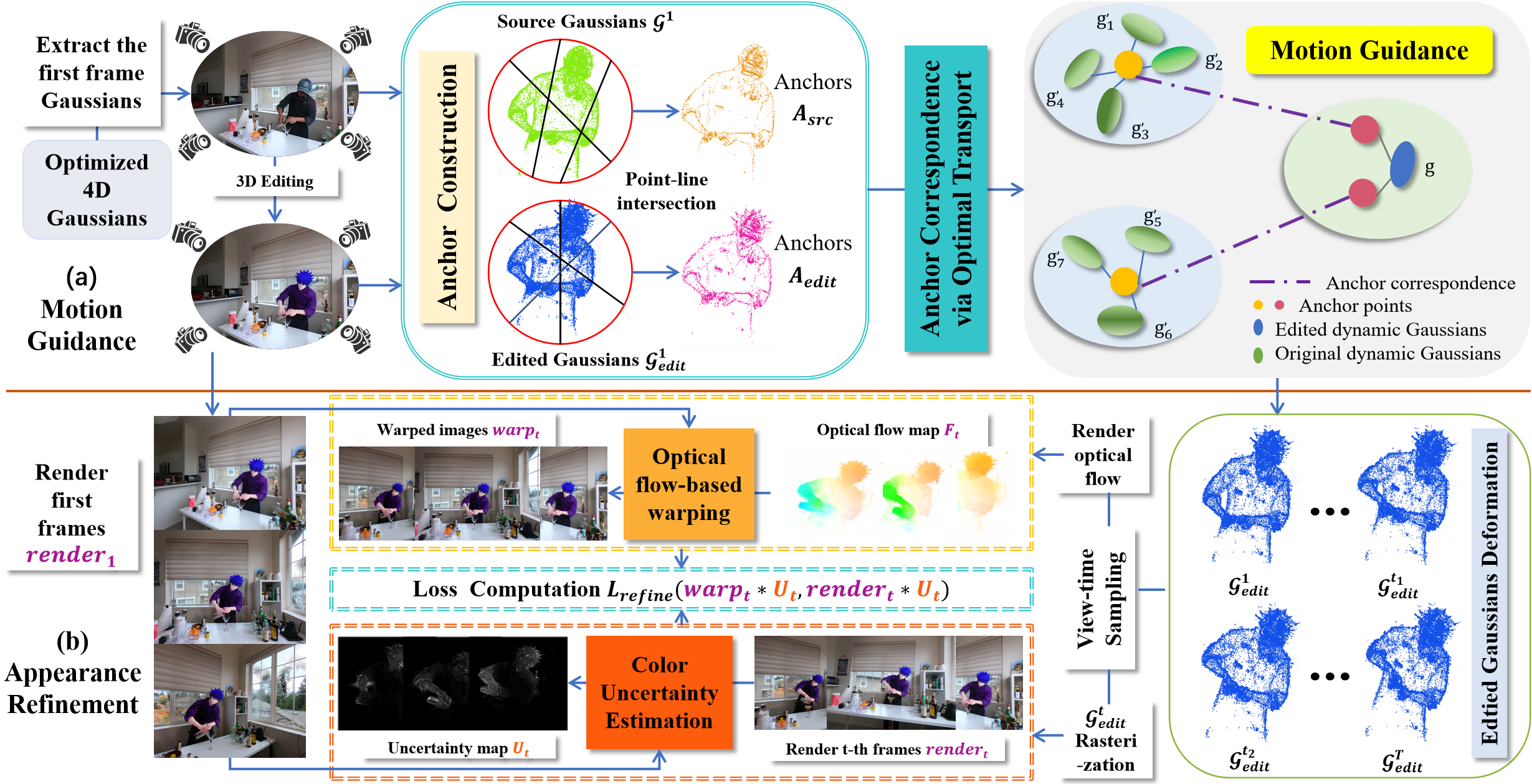
Overview of Catalyst4D. Given the first-frame edited dynamic Gaussians, our (a) Anchor-based Motion Guidance establishes region-level correspondences with the original Gaussians via anchor construction and optimal transport, enabling reliable deformation transfer. Then, (b) Color Uncertainty-guided Appearance Refinement leverages first-frame warping and Gaussian color consistency to identify and correct motion-induced artifacts across time.
Results
Qualitative Comparison
Sear_steak : Turn him into a Minecraft character
Ours
Instruct4D-to-4D
Instruct4DGS
CTRL-D
Coffee_martini : Turn his hat into a newsboy cap
Ours
Instruct4D-to-4D
Instruct4DGS
CTRL-D
Cut_roasted_beef : Turn his clothes into a football player outfit
Ours
Instruct4D-to-4D
Instruct4DGS
CTRL-D
Trimming : Change the leaves of the plants to autumn leaves
Ours
Instruct4D-to-4D
Instruct4DGS
CTRL-D
Discussion : Make the people look like Marble roman sculptures
Ours
Instruct4D-to-4D
Instruct4DGS
CTRL-D
Global Style Transfer
Coffee_martini
Src
Sea_coffee
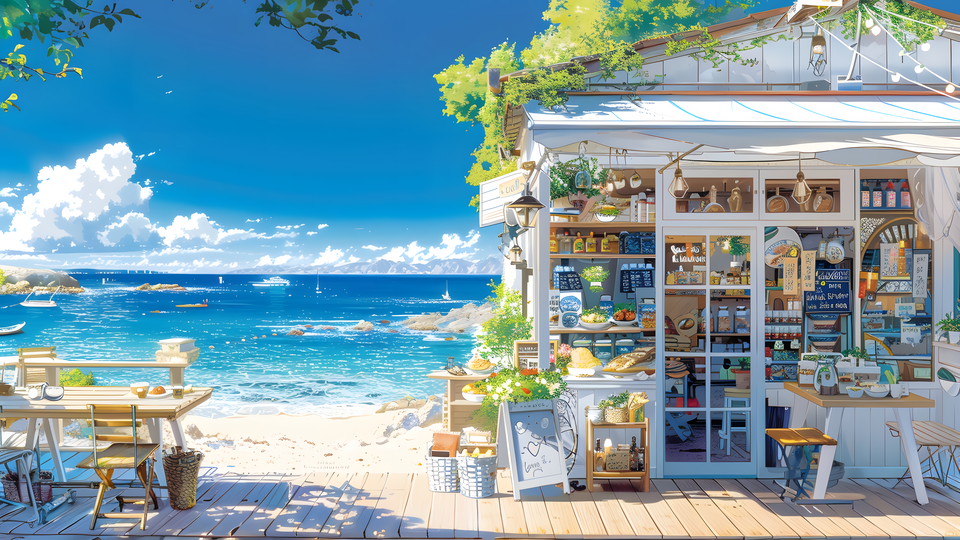
Cartoon_coffee

Autumn_coffee
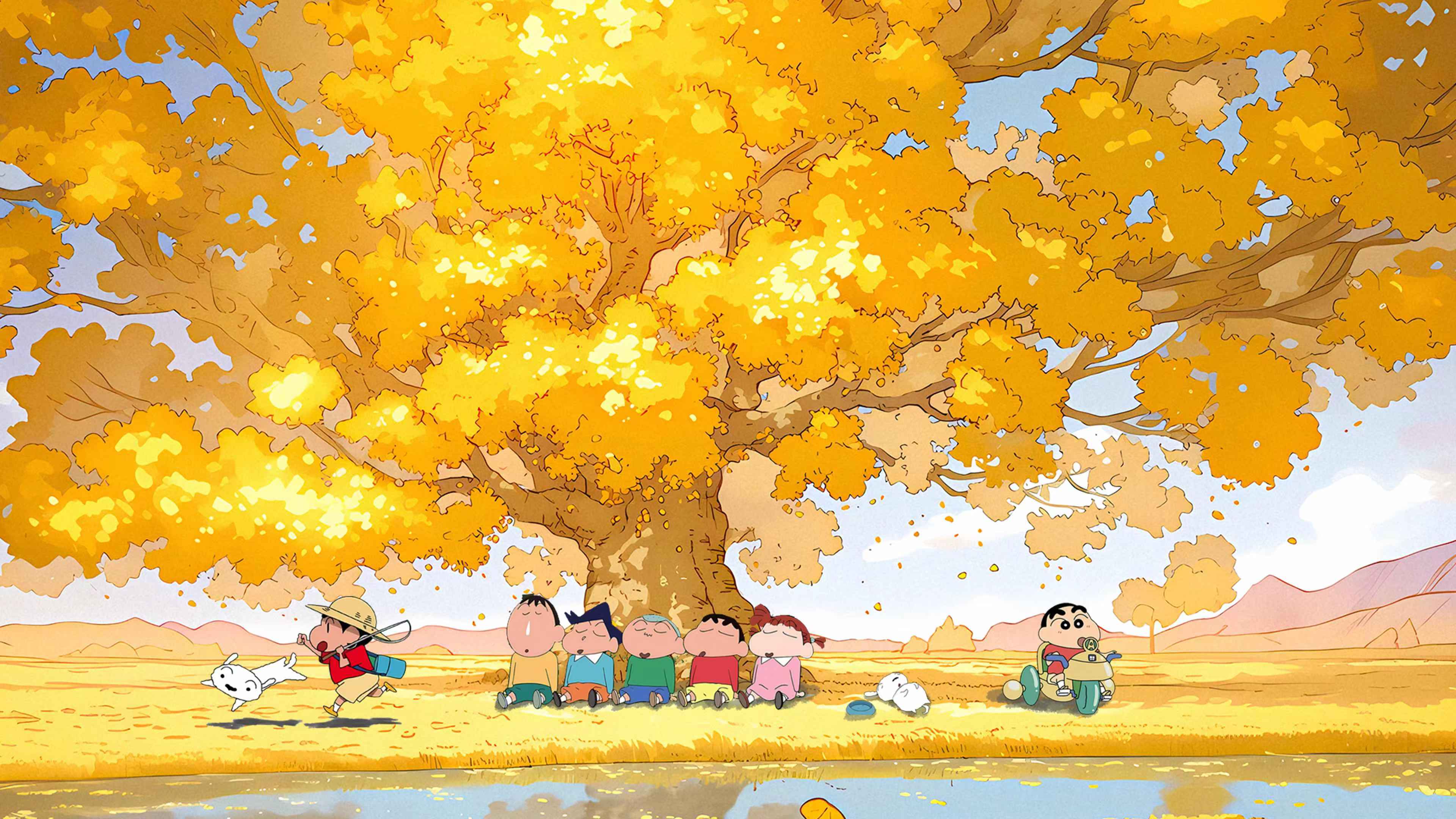
Sear_steak
Src
Cat_sear

Dog_sear

Cartoon_sear

Qualitative Results with Varying Camera Poses
Sear_steak
Original Scene
Turn him into a Minecraft character
Make him wear shoulder armor
Coffee martini
Original Scene
Turn his hat into a newsboy cap
Make him wear a suit
HyperNeRF
Original Scene
Make the torch carved from a flawless emerald
Turn the torch into Pop art style
Original Scene
Turn the extruder into coral style
Make the extruder covered in glacial ice